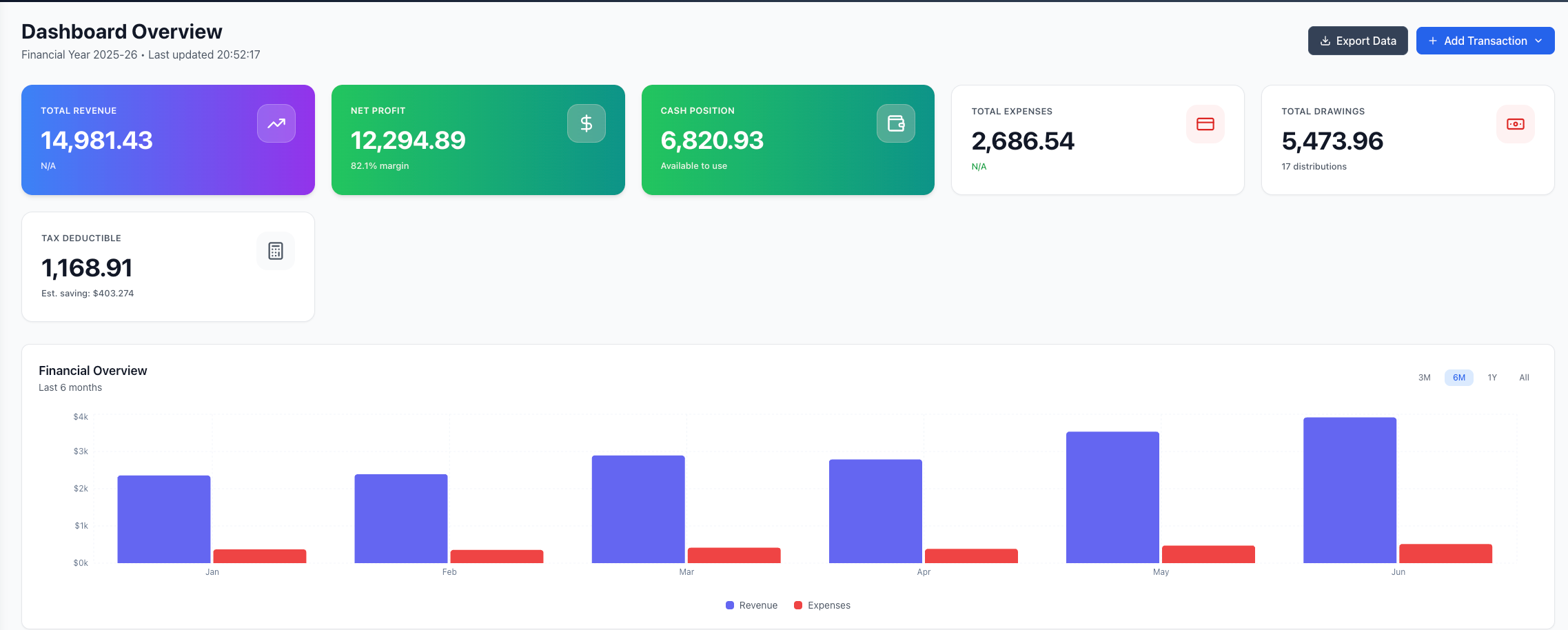
Expenses tracked. Categories done for you.
The starting point for most of these businesses was a spreadsheet and a folder of receipts. Transactions were entered manually, categories were guessed, and the correct tax treatment depended on whoever was doing the entry that week. Month-end reconciliation was a multi-hour exercise in untangling inconsistent data.
The platform replaces that entirely. Every income and expense entry is categorised automatically against the Australian tax schedule. GST is calculated on the way in. The data is always clean, always consistent, and always ready for reporting without a cleanup step before it can be used.
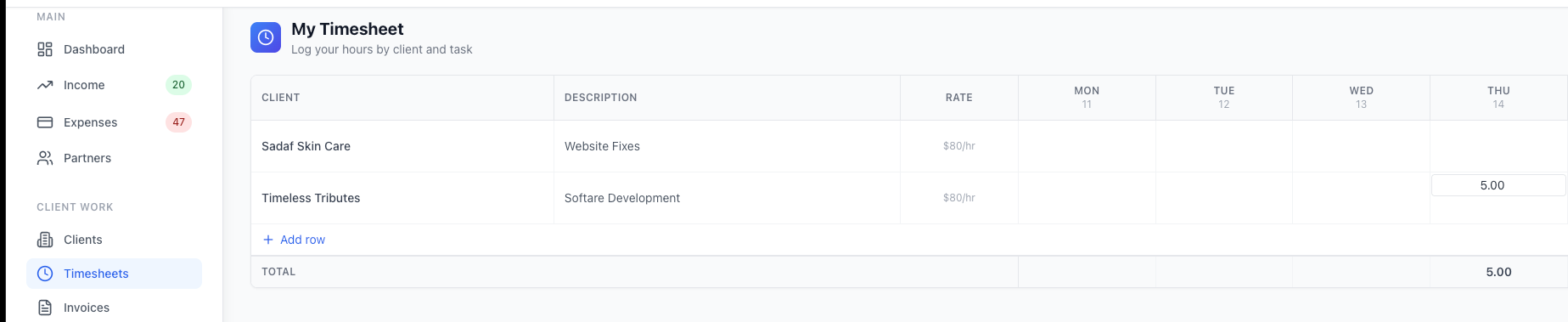
Every billable hour. In one place.
Missed billable hours are silent revenue loss. When time tracking is informal, hours get forgotten between the work and the invoice. A 15-minute call, a quick revision, a follow-up email: individually small, collectively significant over a month.
The timesheet module gives every user a structured place to log time against specific clients and projects. Sessions can be started with a timer or entered manually. Every hour is attached to a client record and a project, creating a complete audit trail that flows directly into invoice generation without any intermediate step.
From logged time to client invoice in one click.
Before this platform, generating an invoice meant opening the timesheet, totalling the hours, opening a template, copying the numbers across, checking the GST, formatting the document, and sending it. That process took the average user two hours per client per billing cycle.
Now it takes five minutes. The platform pulls all logged time for a client within a billing period, applies the configured rate, calculates GST, and generates a formatted PDF invoice ready to send. Nothing is re-entered. Nothing is miscalculated. The invoice that goes to the client matches exactly what was logged.
Built for Australian tax, not around it.
Australian tax requirements for small businesses are not generic. GST registration thresholds, BAS lodgement cycles, the difference between sole trader and partnership treatment, the way income categories map to ATO classifications: these details matter and they are easy to get wrong when the software was not designed with them in mind.
The platform handles all of it natively. GST is calculated automatically on every applicable transaction. Reports are formatted to match the BAS structure so lodgement is a copy exercise, not a calculation exercise. Sole trader and partnership structures are supported with the correct treatment for each, and the schema is built to extend to company structures without requiring a rebuild.